

A year ago, Liam Price was standing at The Long Road hoping that entering a brand-new competition might open a few doors. When he returned to the festival this summer, rather more had changed than he could reasonably have expected.
Winning the inaugural Homegrown Talent competition had taken his own music to CMA Fest in Nashville, brought new listeners to his songs and helped turn growing interest into bigger live opportunities. Back at The Long Road, he was no longer there as a hopeful competitor but as a booked artist, opening the Rhinestone Stage before heading later to the festival’s more intimate VIP setting.
Yet spend a little time talking to Price and the most interesting development isn’t necessarily where he has played or how many more people are listening. It is that the character of Liam Price as an original artist is becoming much easier to see.
For years, many country fans have known him through Luke Combs UK, the successful tribute act that has taken Price around Britain and Ireland and across the Atlantic. It remains an important part of his musical life and, as he readily acknowledges, has given him an audience and experience that most emerging artists would love to have.
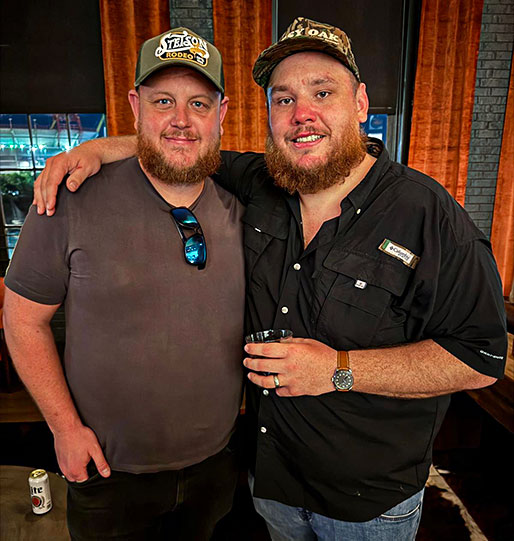
Alongside it, though, something else is taking shape. There is a songwriter increasingly confident about what belongs in a Liam Price song, an artist happy not to know precisely where his music is heading next, and a performer whose ambitions still come with one surprisingly straightforward condition: he has to enjoy what he is doing.
“People see me as Liam Price, which is nice,” he says when we sit down between his two performances at The Long Road. “I am my own person.”
A year that changed everything
Price doesn’t exaggerate what Homegrown has done for him, but neither does he underplay it.
“Going to Nashville, playing these stages, it just brings a lot more attention to you,” he says. “People recognising who you are, following goes up. My streams have gone up on Spotify, which is important now, and the gigs are getting bigger. A lot more buzz around it, which is great.”
Ask whether the competition ultimately delivered what he hoped it might, and his answer is emphatic. He describes the effect on his original music as “life changing” — not financially, he quickly adds, but in terms of the experiences, opportunities and people it has brought into his career.
That little qualification is fairly typical of Price. There are few grand declarations as we talk, even when the past twelve months give him plenty of justification for making them.
Perhaps surprisingly, he doesn’t even identify CMA Fest as the single most important part of the Homegrown prize. Instead, he thinks winning the competition itself may have made the biggest immediate difference. As the first year of a new initiative, there was considerable attention around it, bringing followers and listeners who were discovering Price through his own songs.
“For me, in terms of my original music, it’s life changing.”
Nashville nevertheless provided an important test. Price had been to North America before through Luke Combs UK, but CMA Fest meant walking onto a stage with his own name and asking an American country audience to listen to his songs.
“There’s always a bit of pressure around, ‘Well, OK, who’s this English guy?’” he says.
What he discovered was that geography mattered rather less once the music started. Price says songs drawn from real experiences can travel across the Atlantic because the emotions behind them remain recognisable, regardless of where the person singing them comes from.
Any pressure he felt beforehand quickly disappeared once he was performing, but the experience appears to have reinforced something that surfaces repeatedly during our conversation: Price is interested in country music that reflects the life of the person singing it.
Songs that sound like Liam Price
That is particularly apparent when the conversation turns to The Grass Ain’t Green, his five-track debut EP released in 2025. Its songs venture into relationships, regret and experiences that aren’t neatly resolved, and Price admits that putting some of that material in front of an audience required an adjustment.
“Who has relationships that are like 30, 40 years of bliss?” he asks. “People have ups and downs and rocky roads. Life’s not a straight shot.”
Curiously, writing about those experiences wasn’t necessarily the difficult part. Performing them was.
“It was new for me, but people do come to me and they relate to it and they tell me,” he says. “That means a lot to me.”
For Price, that relatability seems to begin with being able to recognise himself in what he is singing. He jokes that some of the familiar clichés of country songwriting simply wouldn’t make sense coming from him because they don’t describe his life.
“It’s not my life,” he says.
It is a small remark, but perhaps one of the most revealing of the interview. Price has spent years successfully interpreting another artist’s songs, yet his approach to his own material is grounded in something much more personal. A Liam Price song has to belong to Liam Price.
His latest single, Two Horse Town, expands that identity without necessarily defining it. With fiddle and pedal steel in the arrangement, Price describes it as “certainly more traditional”, but anyone expecting that to signal a permanent move into one particular corner of country music may be disappointed.
He has no interest in putting himself “in a shoebox” or pigeonholing what he does, explaining that inspiration can come from different styles. As for where that leaves the next record, he readily admits he doesn’t know — and likes it that way.
“I’m not sure where I’m going next. But that’s the joy of it.”
What matters more is having material worth releasing when he gets there. Writing is his priority, but volume isn’t.
“Just trying to write as much as possible and get some quality out there rather than quantity,” he explains. “Don’t just release for the sake of it. Wait till something’s worth doing and then get it out.”
When everyone already knows the other you
Developing an identity as an original artist becomes more complicated when you already have a successful musical identity.
Price has no desire to pretend Luke Combs UK hasn’t played an enormous role in his career. He describes its existing fanbase as “a huge advantage” and speaks warmly about the support he and the band have received from Luke Combs himself.
For some listeners, however, that remains the first — and sometimes only — reference point.
“Sometimes it’s a hard one to shake off,” he acknowledges. “People just see you as the Luke Combs guy.”
He encountered a particularly good example during his Nashville trip. While there to perform his own material, Price says one of the directors from the Grand Ole Opry approached him and immediately recognised him.
“You’re the Luke Combs guy.”
Price’s reaction was essentially: yes, but this time he was there with his own songs.
He describes that recognition as sometimes being “a bit of a monkey on the back”, but immediately makes clear that he doesn’t regard the association negatively.
“The positives outweigh anything negative.”
That distinction matters. This isn’t the familiar story of an artist desperate to cast off his past and reinvent himself. Price doesn’t sound remotely embarrassed by the tribute work, and there is no suggestion that he intends to distance himself from an audience that has supported him.
Instead, he is adding another dimension to what people already know.
The years spent performing Luke Combs songs have given him extensive stage experience and an understanding of how country songs connect with large audiences. His own material now gives listeners the opportunity to hear what happens when the stories, decisions and personality are his as well.
One Year On: Liam Price After Homegrown
August 2025 – Wins the inaugural Homegrown Talent competition at The Long Road.
2025 – Releases his five-track debut EP, The Grass Ain’t Green.
May 2026 – Releases Two Horse Town, featuring a more traditional country sound with fiddle and pedal steel.
June 2026 – Takes his original music to Nashville for his CMA Fest debut.
The Long Road 2026 – Returns as a booked artist, performing on the Rhinestone Stage and in the more intimate VIP setting.
Next – More songwriting, new music and further opportunities to perform in the USA.
Looking across the Atlantic
Price’s year has also left him thinking about where British country fits into the wider industry.
Having benefited from a competition specifically created to develop homegrown talent before travelling to CMA Fest, he has experienced both sides of a conversation that British artists have been having for years: should the goal be to build something distinctive here, or to seek opportunities in Nashville?
Price doesn’t see much value in choosing between them.
After speaking with the CMA’s international relations team, he believes closer relationships between the British and American country industries could benefit artists on both sides.
“There’s no reason why some of the incredible artists in this country – and we could reel 20 off now – shouldn’t be given a chance in the States,” he says.
He is equally enthusiastic about the possibility of British artists collaborating with American acts. To Price, there is nothing particularly complicated about the principle: working together can create better opportunities for everyone.
It is another characteristically uncomplicated answer. Rather than worrying too much about whether British country needs Nashville’s approval, Price appears more interested in what artists can learn from each other and where those relationships might lead.
‘I’ve got to enjoy it’
The Long Road itself offers a neat illustration of the different sides of the artist Price is becoming.
Earlier in the day he had opened the Rhinestone Stage; later he was due to play a much smaller VIP performance. The bigger platform may bring greater visibility, but there are things he particularly enjoys about being close enough to an audience to see their reactions.
“It’s way easier just to storytell in smaller settings,” he says. “It’s nice to be able to see everyone’s eyes and tell your stories.”
Perhaps unsurprisingly, when asked what needs to happen next for his original career to continue growing, Price doesn’t produce a checklist of industry achievements.
He wants to write songs he believes in, get onto “the right shows with the right people” and continue putting himself in situations where new audiences can discover what he does. At the time of our conversation, that included another trip across the Atlantic, with Price preparing to support Larry Fleet in Virginia.
But there is something else he considers just as important. Whatever happens next, Price doesn’t want ambition to take away the reason he started making music in the first place.
“I’ve got to enjoy it. I can’t get to a point where I don’t enjoy it.”
His priority, as he puts it, is to release new music and enjoy doing it.
It is difficult to find a thought that better captures the Liam Price who emerges during our conversation. There is obvious ambition, and the opportunities created by the past year are being taken seriously, but there is little sense that every song, show or decision is being treated as another rung on some carefully engineered career ladder.
That may also explain why his advice to the next group of Homegrown hopefuls is so simple.
“Do it.”
Price remembers seeing somebody say they were thinking about entering and giving essentially the same response: stop hesitating and say yes. The competition, he says, has given him a great platform and proved life-changing for his original music.
Twelve months after taking that chance himself, Price hasn’t returned to The Long Road claiming to have discovered exactly what the future looks like. In some ways, the opposite is true. He doesn’t know whether Two Horse Town represents the sound of his next batch of songs, he isn’t interested in releasing music simply to satisfy a schedule, and he isn’t setting an arbitrary point at which his tribute work must give way to something else.
What has become clearer is the artist developing alongside it: personal without trying to manufacture a country persona, ambitious without appearing consumed by ambition, and increasingly comfortable allowing his own experiences to determine what Liam Price sounds like.
People may still walk up to him and say, “You’re the Luke Combs guy.”
The difference now is that more of them are discovering Liam Price too.

